
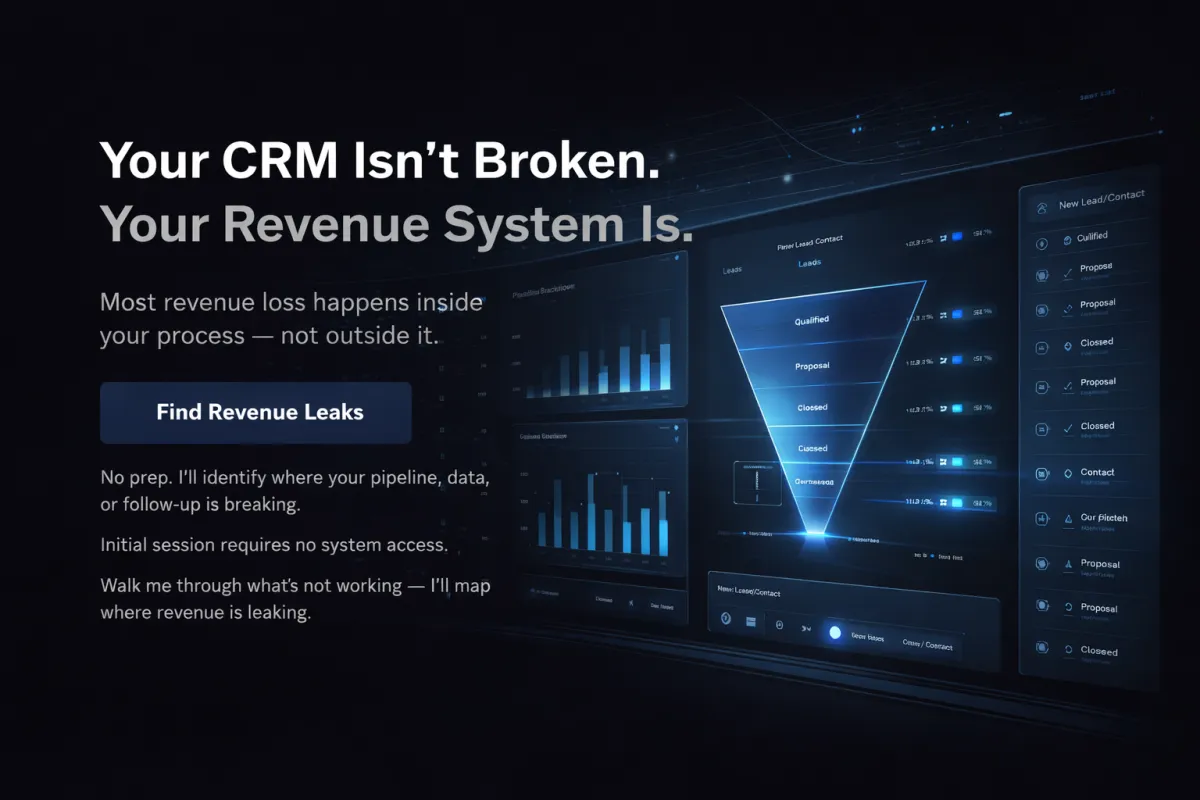
Your CRM isn't broken...
Your Revenue System is.
Trusted by teams at:

Numbers from Engagements
Documented results from systems at prior clients and employers.
40% Reduction in manual account setup effort
Salesforce CPQ deployment — Shockwave Medical / J&J
95% User adoption rate within 30 days of go-live
Salesforce implementation — Palo Alto Networks
60% Improvement in contact data accuracy
Data validation system — freelance client engagement
30% Reduction in quote errors after CPQ implementation
CPQ + revenue ops build — Shockwave Medical / J&J
175k Leads, accounts, and contacts cleaned and standardized
Data hygiene initiative — Whitehat Security
$2MM+ Additional annual revenue supported via Salesforce integration
Integration project — Whitehat Security
The Problem
Most systems don’t fail loudly. They fail quietly.
The problem is not the tool. Its the system.
• Leads come in, but follow-up is inconsistent
• Data looks clean, until you rely on it
• Automations exist, but fail
• Reps work outside the system, because it’s easier
• Forecasts rely on judgment
If your pipeline requires “gut feel,” your system is already failing.
Who This is For
Path A - You already use a CRM
You have the tool. The question is whether the tool is working — or whether your team has quietly built around it.
Most Salesforce orgs have meaningful data quality issues within 18 months of go-live, and most people don't know until they try to trust a forecast.
What about:
• Duplicate and stale data
• Broken workflows nobody noticed
• Reporting that doesn’t match reality
Path B - You don't have a system yet
You’re running:
• Spreadsheets
• Email threads
• Notes
• Memory
It works — until it doesn’t.
Leads slip. Follow-ups get missed.
You can’t see what’s actually converting.
Where Users Find Gaps
Duplicated / Unreliable Data
Contacts entered twice. Companies with three spellings. Fields that nobody fills in consistently. Your reports & dashboards are outdated.
Broken Automations No One Notices
That nurture sequence from 2018? Three of the five steps still work. The others hit an error nobody noticed. The CRM still shows leads as 'warm'
Reps Working Around the System
Notes go to Slack. Follow-ups get tracked in personal spreadsheets. The CRM becomes a reporting artifact for management, not a working tool for the people closing deals.
No Attribution
You can't tell which source, campaign, or channel actually produces customers. You're reinvesting based on what feels right, not what the data says.
Forecasts You Can't Trust
If your forecast requires “gut feel,” your system is already failing.
I don't replace your CRM system. I audit what you have, fix what's broken, and build what's missing.
What a Gap in the System Costs
These patterns show up consistently across revenue audits, regardless of company size or industry.
47%
of leads never receive a second follow-up attempt
5x
more likely to qualify a lead reached within 5 minutes versus 30 minutes
30-70%
of revenue lost inside the process — not from a lack of leads
Having the right tool is not the same as having a working system. The gap is almost always in implementation and adoption, not in the software itself.
Where Systems Break
I don't hand you a playbook... I build and hand you the keys.
Revenue audit — map the gaps first
A systematic review of where leads enter, where they stall, and what your data actually reflects versus what you think it reflects. For existing CRM users: data health check, automation audit, pipeline stage review. For new setups: process mapping and baseline capture design.
System build — CRM, capture, and automation
Implementation or CRM cleanup: lead capture forms, pipeline stages, landing pages, pipeline stage design, automated SMS and email follow-up sequences, lead routing, and clean integration with your existing stack.
Data hygiene — clean what exists
Deduplication, field standardization, integration monitoring, and a data health baseline your team can trust. For Salesforce orgs: object cleanup, permission audits, report rebuilds, and workflow validation. A system should get more accurate over time, not less.
Handoff — built for your team to actually use
A system nobody opens is worse than no system — it creates false confidence. I build for how teams actually work, not how they're supposed to work. Documented workflows, clean UX, a dashboard your team will open. No ongoing consultant required.
Find the Gaps in My System
What Clients Report After 90 Days
"We'd had Salesforce for two years. The audit found over 4,000 duplicate contacts, three broken automations, and a workflow that had been silently failing for the better part of a year. The data cleanup alone changed what our pipeline forecast actually meant."

"I was running my entire client list out of a spreadsheet and a notes app. Three weeks later I had a working pipeline, automated follow-up for every lead form submission, and for the first time I could see which referral sources were actually converting."

“As VP of Sales, I had zero visibility into expiring trials and couldn’t trust our forecast. Marc Victor fixed that—giving us real-time pipeline visibility and automated alerts so my team could act before deals slipped.”

What a Broken CRM Costs
• Leads not followed up = lost revenue
• Dirty data = wrong decisions
• Broken automation = silent pipeline failure
• Lost leads you already paid to acquire from expensive marketing campaigns
• Inconsistent follow-up = inconsistent revenue
• No forecasting = no clarity
• Your team guessing instead of executing
Most businesses are losing 30–70% of their revenue inside their own process.
I Fix Revenue Systems in 3 Steps:
Find the leaks
Map where leads enter, where they stall, and where data breaks.
Fix the system
CRM cleanup or build automation, pipeline structure, lead routing.
Make it usable
by your team
Built for how your team actually works — not theory.
That’s how I drove 95% adoption.
How This Works:
Step 1 - AudiT
We identify where your system is leaking revenue.
Step 2 - Build
We design and implement your CRM + automation.
Step 3 - launch
Your system is live, structured, and working.
Frequently Asked Questions
Save Time And Manage Your all projects easily
Do you work with existing Salesforce or RevOps teams?
Yes. Most engagements involve auditing and improving existing systems without disrupting your team.
What if we don’t have a CRM yet?
That’s fine. I design and implement systems from scratch — structured correctly from day one.
How does CRM software improve communication with clients and customers?
CRM software helps automate communication, track messages, schedule follow-ups, and ensure timely responses, improving your overall communication efficiency and ensuring that no customer inquiry goes unanswered.
How does CRM software help track leads and sales performance?
CRM systems offer lead tracking and performance analytics, allowing you to manage sales pipelines, track customer interactions, and identify which strategies drive conversions, helping you make data-driven decisions to close more deals.
How can CRM software help improve my customer retention?
CRM software centralizes customer data, enabling you to track interactions, monitor behavior, and send personalized follow-ups. This helps build long-term relationships and increase retention by delivering tailored experiences and proactive support.
Can CRM software be customized to suit my business needs?
Yes, most CRM platforms offer customizable features such as automated workflows, reports, and dashboards, so you can tailor the system to match your business goals, industry requirements, and customer engagement strategie
How does CRM software integrate with other business tools?
CRM software can seamlessly integrate with various business tools like email marketing platforms, social media, and analytics tools, providing a unified experience and reducing manual data entry.
What kind of businesses benefit from using CRM software?
CRM systems offer lead tracking and performance analytics, allowing you to manage sales pipelines, track customer interactions, and identify which strategies drive conversions, helping you make data-driven decisions to close more deals.
© 2026 Victor Consulting LLC - All Rights Reserved.